Capitalism, Ghosts, and the Sublime: The Philosophy of the Urban Wasteland
Note
This essay was originally written four years ago. Since then, the landscape of internet discourse on liminal spaces has shifted dramatically. With the theatrical release of Kane Parson’s Backrooms, the urban wasteland has saturated the wider cultural consciousness. Now more than ever seems the perfect time to make this essay public. It’s also my first blog post!
“It is so quiet out here, it is the quietest place in the world.”
— Andrei Tarkovsky, Stalker
Introduction
Summer, 2020. Quarantine. I spent my days scouring Google Earth for the telltale markers—strange clearings in the trees where the deep hue of rust shone through—and I spent my nights following the enigmatic map I had created. I was on the hunt for something I couldn’t pinpoint, places that evoked a feeling I didn’t have the words to describe.
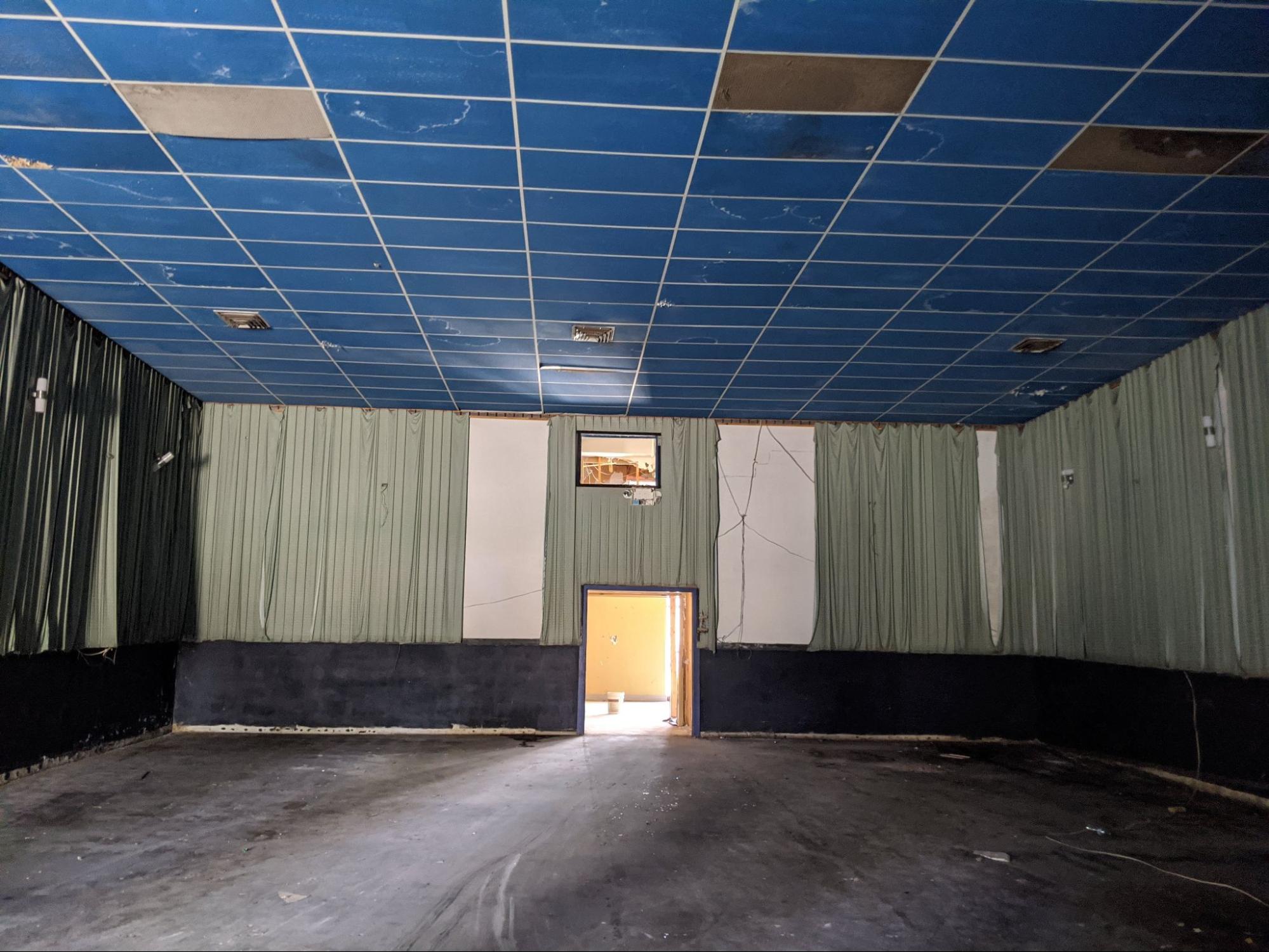
The first stop on my treasure map was the ethereal Plaza VI Theater. Or what remained of it. The haunted building sat in my peripheral vision for years, just a block away from the Bank of America that gave me mints on lazy Friday afternoon errands with my mother. But I hadn’t noticed it until now. It was hiding from me, keeping a secret that I wasn’t allowed to know. I had to get into that building before it was demolished and its secret along with it.
With two friends in tow, I set out. An unlocked door at the rear of the building granted us entry, as if the rotting structure were opening itself, letting us in on the secret.
Immediately, I was hit with a ghastly odor. Gone was the overpowering smell of popcorn butter wafting through the air; in its place was the pungent stench of mold. This abandoned theater once promised matinee showings of Star Wars and birthday parties and popcorn. That promise now sat rusting away, decaying in the Texas humidity.
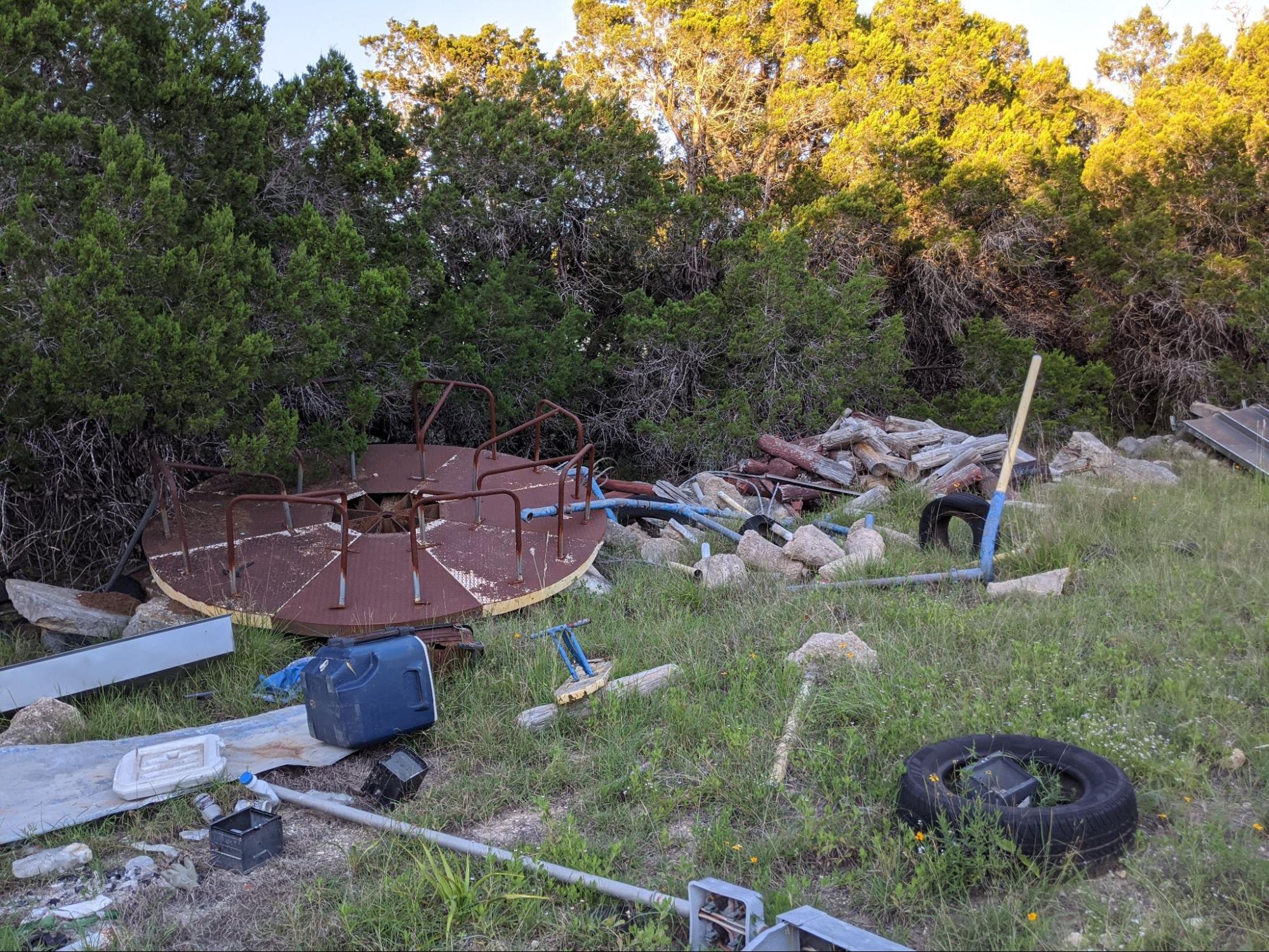
What is so evocative about these “urban wastelands”? What is it about the crumbling farmhouses that dot West Texas highways, the disused rail bridge my friends and I climbed in teenage rebellion, and the dumping grounds for my school district where the merry-go-rounds and steel park slides of my childhood lay rusting? On sleepless nights, these places haunt me.
The Sublime: Reflections on Ruination
As it turns out, I am not the only one haunted by urban wastelands. A wealth of landscape architects, cultural theorists, and philosophers share a similar fascination in architectural journals and essay collections, and a common thread runs through their writing—the sublime.
But what is the sublime? Despite its dry origins as a tool in aesthetic critique, the sublime is an innately human concept. In philosopher Edmund Burke’s leading definition, the sublime refers to the terror we experience when faced with sights or concepts that exceed our senses’ ability to capture them. The sublime and the beautiful evoke two different responses, Burke argues (Fitzgerald, 2021). Whereas beauty is purely pleasurable, sublimity is equally terrifying and pleasurable. Immanuel Kant expanded on what makes the sublime experience pleasurable in spite of its terrifying nature, distinguishing between mathematical sublime and dynamical sublime (Fitzgerald, 2021).
Mathematical sublime occurs when we try to comprehend what is fundamentally incomprehensible. The chills that run down one’s spine when gazing at the night sky, trying to imagine just how far the stars stretch—that’s the mathematical sublime. We’ve hit the limits of our senses, yet we’re still able to appreciate the magnitude of what we see. It’s certainly a pleasurable experience; why else would we stargaze?
On the other hand, there’s dynamical sublime—the aspect of the sublime experience founded on terror. Kant argues that terror becomes sublime when we are able to appreciate it without experiencing any real danger. Dynamical sublime brings us in touch with our mortality and gives us the freedom to appreciate our own fear and contemplate the sublime object. According to Kant, sublimity is equal parts incomprehensible magnitude and contemplative terror.
What does philosophical theory have to do with urban wastelands? Ask Dr. Helen Armstrong, a professor of landscape architecture at Queensland University of Technology. Armstrong studies derelict industrial landscapes in post-Soviet Europe; these sprawling “landscapes of contempt” are littered with the rusty remnants of Soviet factories, in places so overtaken by nature that the ruins become a part of it. Armstrong points to a mining region in the former German Democratic Republic, where impromptu lakes are slowly filling in the mangled landscape. Nature’s power is on full display—we experience mathematical sublime through the vastness of the landscape and dynamical sublime through the beautiful horror of its industrial decay. Armstrong calls on the French term Terrain Vague to describe the ruins: places forgotten by urbanization, where nature has taken root. But there was nothing vast about the Plaza VI Theater, and while its decay was unsettling, that couldn’t be the only source of its sublimity. There had to be something else behind the uncanniness I felt in urban wastelands.
A few borders from Germany, another post-Soviet town—Tallinn, Estonia—is home to a textbook Terrain Vague: a former industrial fishing harbor. Once a thriving economic hub, the harbor fell into ruin in the later years of the Soviet Union, awaiting redevelopment that never began.1 Landscape researchers Anna-Liisa Unt, Penny Travlou, and Simon Bell wanted to know: What uses and meanings do derelict landscapes like the fishing harbor lend themselves to? To find out, they observed and interviewed members of the Tallinn community and discovered that the unregulated nature of the area attracted inhabitants:
Children enjoy playing with the pebbles while their parents use the opportunity to sunbathe in privacy, although they are in the centre of the city, or to sit in the shade of the spontaneous vegetation. … Some groups have chosen the site as their place of summer residence, living in the open air among scraps of material that they have gathered around them. Other groups, such as young people, come occasionally to drink and party at night. The wilderness is appreciated for its colours, force, seasonality, shelter and shade. The site functions well as an alternative to nearby parks, as nothing is forbidden and proper behaviour—the kind that is expected in public places: socially acceptable, not criminal and offensive—is not enforced. The space is loose, therefore the potential of the environment allows the unpredictable to take place (Unt et al., 2013).
Unt and her colleagues ultimately conclude that the indeterminacy of the landscape and the unique qualities of wilderness brought visitors. People came to the site to “gain a sublime experience—although they may not refer to it as such” (Unt et al., 2013). The researchers found that younger generations were attracted to the dereliction and the resulting “looseness” of the space, but for older generations, there was more at stake. For them, the post-industrial space embodied a memory of Soviet occupation. The site was haunted by its Soviet past and its promised redevelopment. The haunting leads to an environment that is “both welcoming and challenging” (Unt et al., 2013). Much like birthday laughter and the smell of popcorn haunted the Plaza VI, Tallinn’s blighted fishing harbor is haunted by dreams that lay dormant for decades.
Who’s Afraid of Ghosts?
Tallinn, it just so happens, is the primary shooting location of one of my favorite films: Stalker, directed by Andrei Tarkovsky. Stalker takes place in an unnamed country where a mysterious phenomenon called the “Zone” has appeared. The Zone is a heavily protected wasteland where time and space are out of sorts. Within the heart of the Zone lies the mythical “Room,” which is said to grant the deepest desires of anyone who enters it. The film follows a “Stalker,” a guide who leads two trespassers to the Room.
Stalker is a contemplative “science fiction” film (almost nothing “science fiction” actually occurs) and is traditionally analyzed for its commentary on faith. John A. Riley, a film critic in London, proposes an alternative reading of the film from the perspective of Hauntology.
French philosopher Jacques Derrida coined the neologism “Hauntology” in his 1993 book Specters of Marx to refer to the ghostlike reappearance of ideas thought to be “dead.” Since then, the term has been broadened by cultural theorists to describe the temporal qualities of certain art and architecture. One theorist, Mark Fisher, spearheaded the use of the term within music criticism, and his arguments are applicable across a variety of fields and forms. In the early 2000s, Fisher noticed a strange phenomenon in electronic music—it could no longer produce sounds that were suitably “futuristic.” The future had been reduced to a formula.
For Derrida,2 the lack of imagination for the future harmonizes with Francis Fukuyama’s belief that we have reached the “end of history”—the era where capitalism is the predominant economic system and envisioning an alternative is impossible. The past’s imagination of what the future could look like is dead, reduced to a ghost. But the thing about ghosts is—they stick around.
Hauntology is the study of cultural ideas that persist long after their perceived end, and it’s the theoretical framework needed to comprehend the haunting feeling of urban wastelands. Hauntology is the imagined popcorn and nostalgic excitement that lingered in the stuffy air at the Plaza VI. Places haunted by the failure of the future provide a valuable refuge in the modern urban landscape. In late capitalism, cities are becoming increasingly homogenized. Haunting, Fisher argues, is intrinsically resistant to that homogenization of time and space; it happens when a place is stained by time, or when a particular place becomes the site for an encounter with broken time (Fisher, 2012).
Stalker is one big encounter with broken time. Time in the Zone is ineffably warped. From a filmmaking perspective, shots are held for an excruciatingly long time, forcing the viewer to become as familiar with the passage of time as with the film’s main characters—Tarkovsky referred to cinema as “sculpting in time.” But most of all, the shooting location itself is stained by time. Stalker was released in 1979, just over a decade before the end of the Soviet Union, and the economic stagnation of the Brezhnev era looms over the film. The area surrounding Tallinn lay in ruin; its future failed to arrive long before Tarkovsky captured its ghost with a camera. Riley notes that every film is, in some sense, about the culture and era that spawned it (Riley, 2017). Cinema is a medium particularly apt to capture uncanny encounters with time; according to Derrida, it is “the science of ghosts.”
The supernatural elements in Stalker flow entirely from the environment’s uncanny atmosphere. The waterlogged landscape is littered with industrial ruins, half-buried Soviet cars, and shattered telephone poles that reach forth from the wasteland like the fingers of a vengeful spirit.
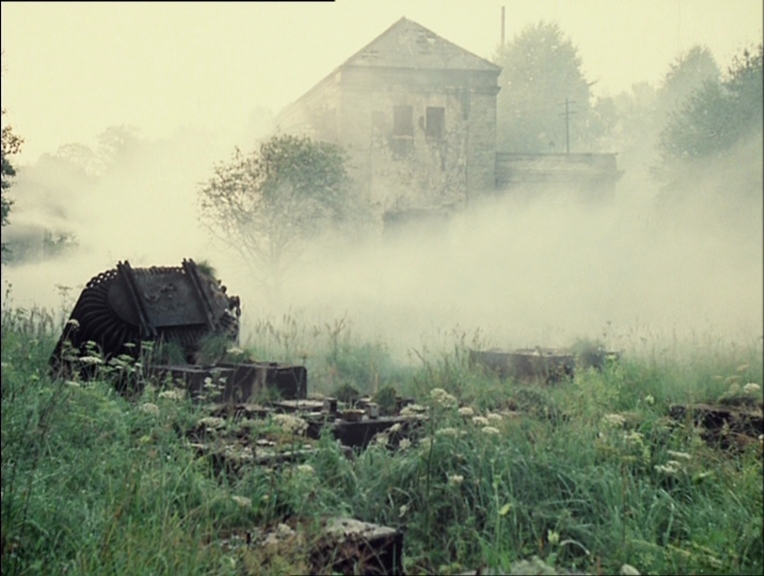
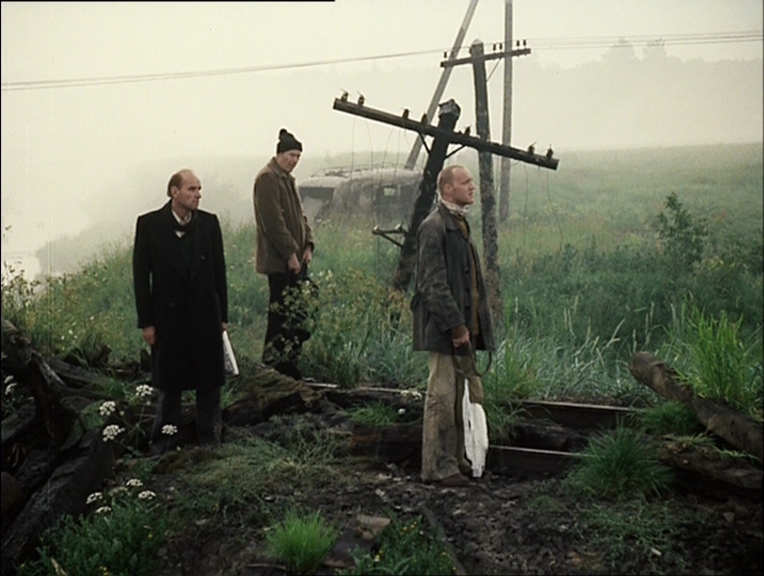
Furthermore, Stalker’s landscape has been devoured by nature. The majority of the film’s interiors are flooded. Vines and other foliage obscure the exterior of the Room. Rust and debris mark nature’s power over the ruins. The wasteland is sublime because it’s stained by time. It forces us to comprehend the past and the present all at once. It resists the homogenization of time and space, removing the comfortable linearity of everyday experience. Within urban wastelands, we confront the incomprehensibility of time’s passage, which Kant asserted is the source of mathematical sublime. The physical scale of urban wastelands like the Plaza VI is subordinate to the temporal scale—the scale of time we experience within them. Similarly, while we see the power time has exerted over urban wastelands and the horror of the resulting decay, we are able to contemplate and appreciate the existential fear it evokes in us, resulting in an experience of the dynamical sublime. This led me to wonder—is decay the only source of broken time? Can a landscape be “stained by time” without being physically stained at all?
What Makes a Ruin?
I decided to revisit a past favorite video game of mine, Garry’s Mod (Gmod for short)—a sandbox game released in 2006, built using assets from Half Life 2. Gmod’s allure is its near-infinite customizability. Players are encouraged to share their own models, gamemodes, maps, and design the exact game that they want to play together. Much of Gmod’s hilarity comes from the juxtaposition owed to its source material, Half Life 2, which is set in post-apocalyptic Eastern Europe. Gmod uses Half Life 2’s ruined textures, models, and sounds to create entirely new spaces. In its multiplayer mode, this has a comedic effect—players dressed as Spiderman and bags of Doritos chips (yes, really) act out gritty crime dramas in anachronistic environments.
But in the absence of other players, Gmod’s multiplayer worlds take on an exceptionally eerie quality. Their haunting atmosphere stems not only from the dereliction of the environment, but equally from the lack of players. These worlds were created to be inhabited, and without anyone around, they become suspended, waiting to be enjoyed by players who will never arrive.
Sociologists Vincent Miller and Gonzalo C. Garcia sought to further explore the notion of “digital ruins” through hauntology. Miller and Garcia argue that forgone utility is inherently what makes a ruin; ruins are spaces which were designed for a purpose that has been abandoned. They differentiate between ruins and mere spatial decay—ruins are not so much abandoned spaces as places which have abandoned their contextual utility, their ability to produce specific experiences tied to their original structures (Miller & Garcia, 2019). Ruins are places for which the future has failed to arrive, and their decay is a physical marker of that failure. But within digital ruins, there are entirely new markers to convey the failure of the future.
Miller and Garcia document their experiences with digital ruins, navigating “derelict” social spaces in games like Second Life and Blue Mars. They write about a virtual theme park in the game Active World simply called “America,” filled with fully functioning roller coasters, arcade games, and fun houses dotted around perfectly pristine park architecture. Decay is nowhere in sight; Miller and Garcia argue that because the park still functions, it is haunted by the traces of players who used to populate it. In the absence of park goers, the fairground music eerily juxtaposes the empty environment:
This was a place to be enjoyed as a space and admired as a construction. But now the dominant experience is tied to its overwhelming emptiness, and the accompanying soundtrack, which could speak of kitsch and fun, becomes forlorn, ironic and melancholic simultaneously, giving a haunting quality – a dreamlike experience of the uncanny, not because we are unable to understand the process by which something gets abandoned or unused, but because it can still be used as well as ever. Its social purpose underlines a feeling of emptiness while also projecting the hauntology of imagined presences, not only of a past, but of a future that could have been, had the world succeeded (Miller & Garcia, 2019).
Digital ruins are haunted by the same dreams for the future that haunt Tallinn’s harbor and other urban wastelands. The ruins are stained with the utopian promise of the digital world and its abundance. The draw to digital social spaces is their limitless freedom; Miller and Garcia compare this freedom to what Marx theorized would be possible after capitalism. Digital utopias provide opportunities for people to explore their creative instincts with unbounded resources. Marx referred to these instincts as “species being”—the impulse to build, create or transform matter into things which carries on in humans even after our physical needs are met (Miller & Garcia, 2019).
But at the end of the day, players return to the real world. Social and economic obligations take precedence over escapism into a digital Marxist utopia of super abundance. The dreams of a digital future, the thousands of real man-hours poured into digital worlds, the traces of people who once populated those worlds—all haunt digital ruins.
I often find myself revisiting a Gmod world entitled “gm_adventurers.” The map is a lovingly-crafted recreation of the defunct Adventurer’s Club at Disney World, a former interactive theater experience akin to the Enchanted Tiki Room. While the Adventurers Club was quickly demolished after its closure in the real world in 2008, its presence still haunts the digital world. The map is packed with detail and interactivity, similar to the functioning theme park elements of “America.” Big band music that once played in the real-life Adventurers Club rings out through the deserted building. The roleplayers who once occupied the baroque space are now long gone, but their presence can still be felt. Even the presence of the map creators lingers; one room is decorated by a plaque displaying their names and profile pictures. Every corner of “gm_adventurers” is packed with detail. The space is pristine, save for the anachronistic decayed textures of Half Life 2 sprinkled sparingly throughout. One significant change made in the digital recreation is the exterior environment of the building. The ultra-detailed interior stands in stark contrast to the barren, endless landscape it occupies. The building sits on a waterfront, the water stretching uncomfortably far into the darkness.
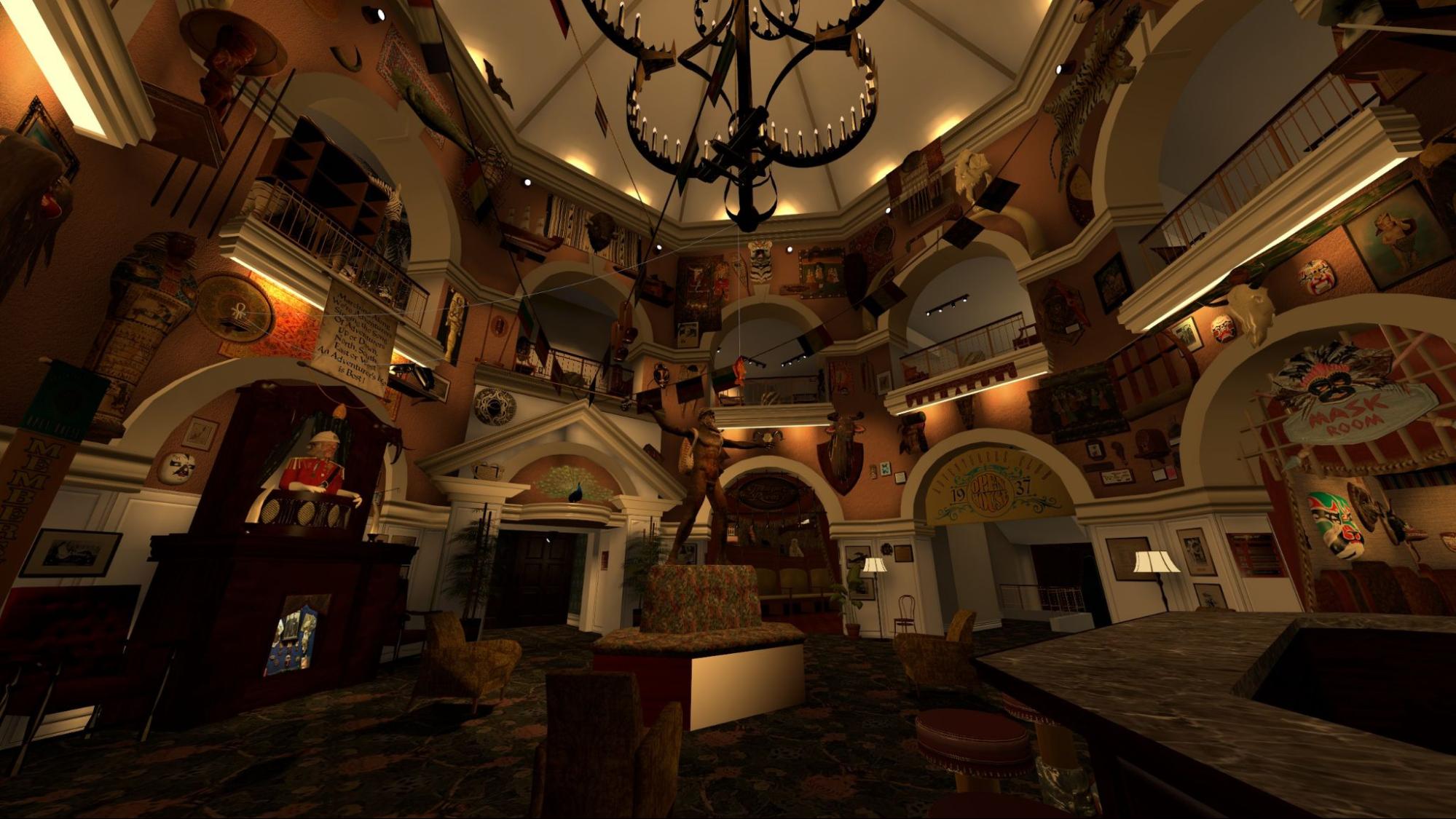
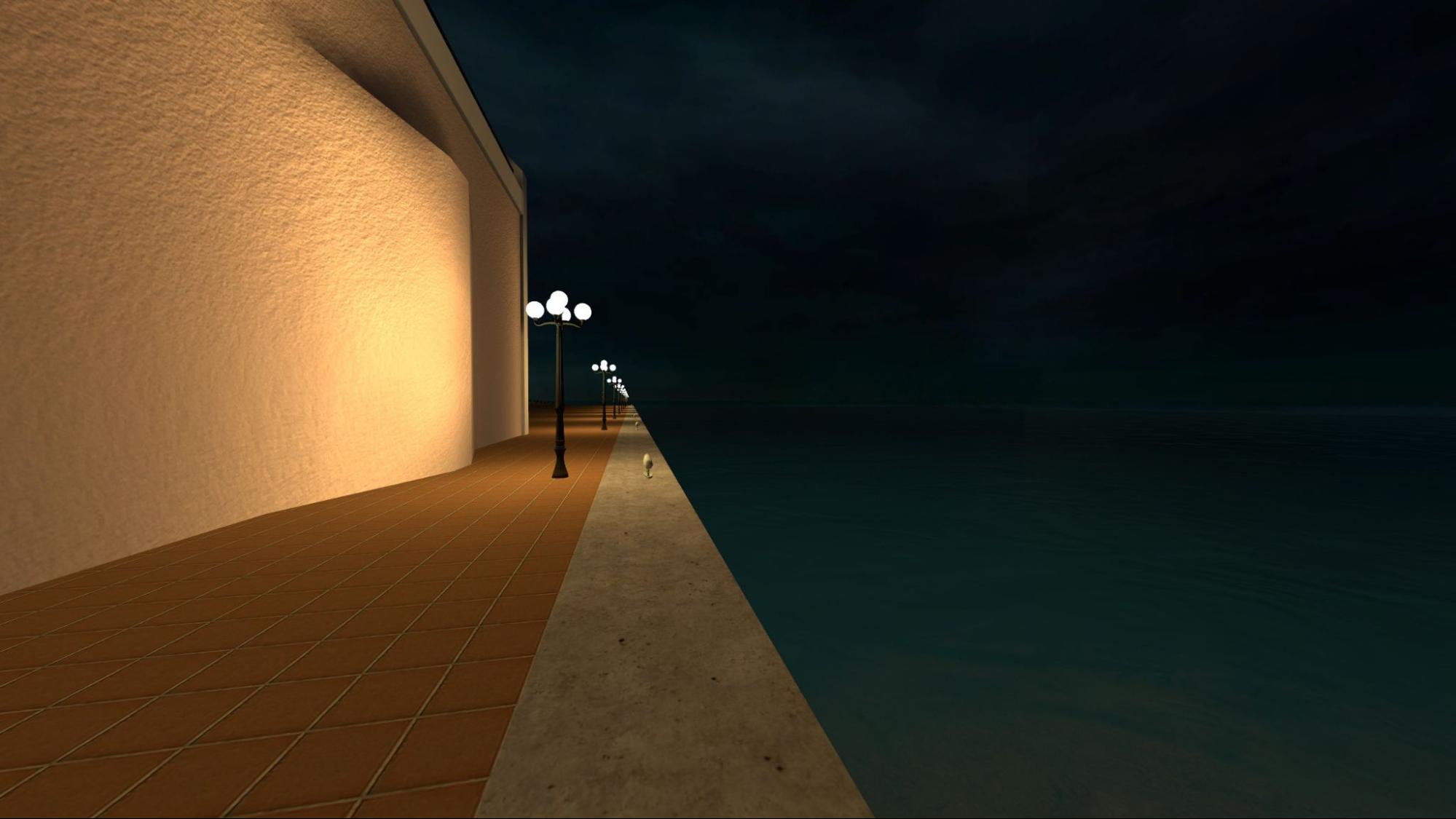
Ruins gain their sublimity from their uncanny embodiment of time, but whether time is embodied materially through decay is less important. Rust and mold are capable of evoking a sublime experience equally as well as pristine abandonment. The temporal nature of ruins can be described by the term “liminal space”—space in transition. Liminality, an anthropological term, refers to the threshold stage between two important phases in life. Liminal spaces are thresholds in time; they are suspended between their forgone utility and their future repurposing, if it ever arrives.
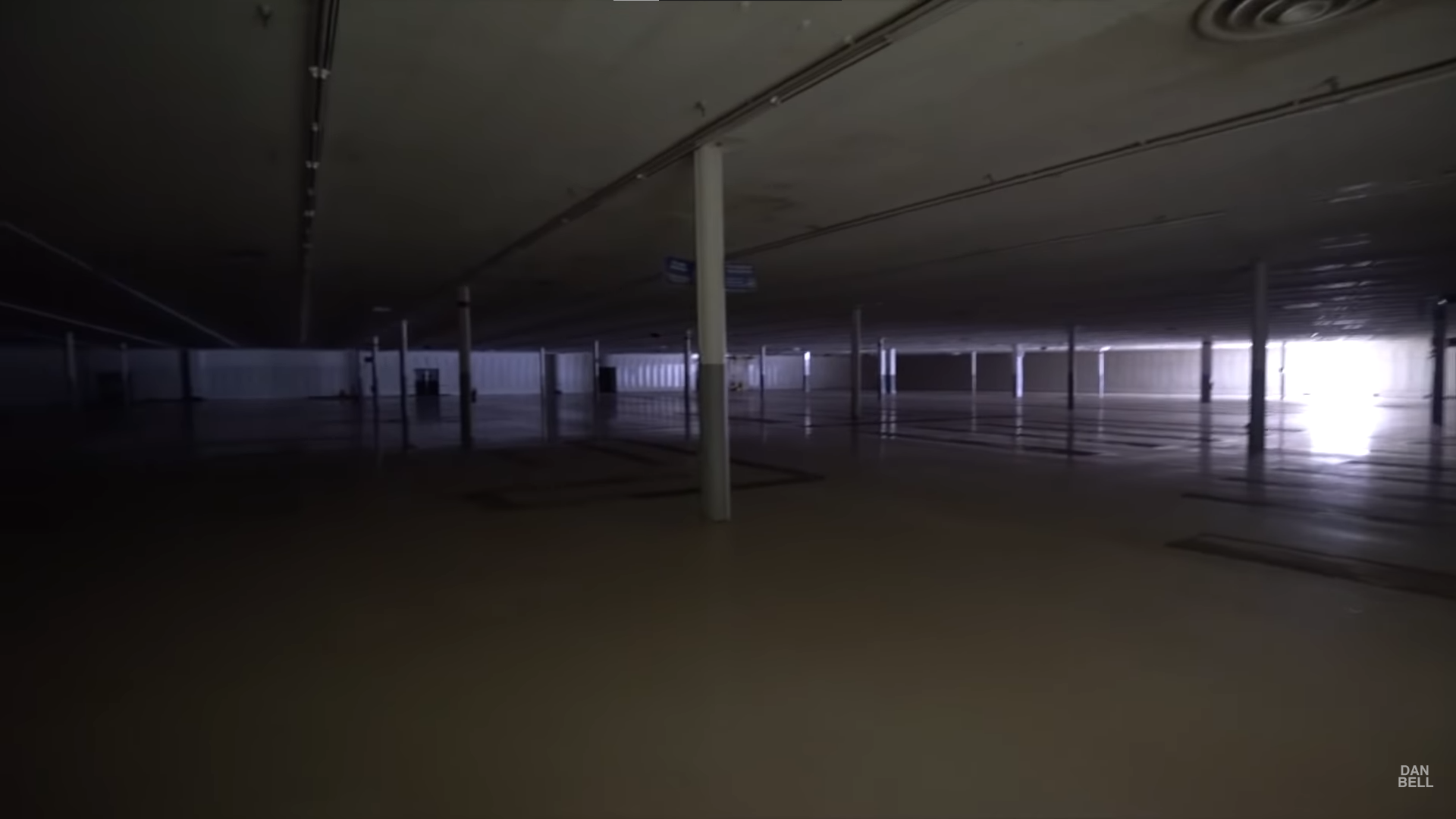
A favorite YouTuber of mine, Dan Bell, documents liminal retail spaces in his bluntly-titled “Dead Mall Series.” With minimal commentary, Bell carefully explores malls and other retail spaces in various states of decay, or sometimes on the brink of closure. In the episode “The End of Kmart,” Bell records a Kmart store in its final months. He visits the store a few times during its liquidation and once after the building becomes abandoned. There is very little physical decay in the store, but the slowly emptying shelves are haunted by the heyday of brick-and-mortar retail—Black Friday crowds and back-to-school shoppers. Halfway through the video, Bell recounts memories of Kmart’s Blue Light Specials—limited deals that shoppers would be notified of by a flashing blue light. Bell recalls watching groups of old women eagerly await the Blue Light Specials over coffee and slices of pie. Between the empty shelves, we can feel them waiting still.
Eventually, even the shelving and other fixtures start to go, leaving only the original warehouse-like structure, suspended.
An Unhealthy Internet Obsession
In my early days of exploring urban wastelands, I took to the internet to find out if anyone shared my excitement. To my surprise, I discovered a thriving internet subculture dubbed “urban exploration.” Urban exploration (UE) is the practice of exploring and documenting abandoned and liminal spaces. Urban explorers typically share photos and videos of their experiences to YouTube and dedicated UE forums. Some creators are thoughtful—Dan Bell’s Dead Mall Series treats its subjects with respect, framing them with nostalgic stories and quiet hauntological renditions of retail background music.
Others choose to exploit their subjects. UE YouTubers are primarily responsible for proliferating “ruin porn”—the aestheticization of urban and industrial decay (Riley, 2017). According to Riley, the popularity of the genre is driven only by a voyeuristic desire to trespass beyond the “no entry” signs. Stalker’s recent rise in popularity among Western audiences3 can almost certainly be attributed to the proliferation of ruin porn. As a result, despite predating it by decades, the film has been criticized for playing into the trend. Riley argues that although ruin porn has given Western audiences an aesthetic framework to the appreciation of Stalker, the criticisms leveled against the film show an unwillingness to engage with ruins and decay as an aesthetic and thematic strategy that is explicitly hauntological (Riley, 2017).
Likewise, instead of engaging with decay in a contemplative manner, many UE YouTubers focus on easily-digestible spectacle. Explorers title their videos in predatory clickbait fashion, utilizing eye-catching phrases like “ABANDONED,” “GHOST TOWN,” and “GONE WRONG.” Their thumbnails display dramatic scenes of decay—creators often use elements of the environment as props to tell a story, prominently displaying rusty wheelchairs or horrifying children’s toys. In the videos themselves, creators often force animated reactions to their environments, playing up the supernatural fears that urban wastelands naturally provoke with cartoonish commentary.

Criminologist Theo Kindynis argues that UE, previously a subversive culture, has devolved into pure spectacle. Urban explorers are increasingly competing against each other to capture the most horrifying decay, amass the greatest following, and perform the most daring stunts (Kindynis, 2017).
When urban exploration pushes further into spectacle, it loses sight of the temporal value unique to urban wastelands. Furthermore, it actively buries the value those spaces offer—UE content creators reduce urban wastelands to commodities, iconography with the sole purpose of attracting views on YouTube.
The commodification of urban wastelands isn’t unique to UE circles. Take the immensely popular internet horror trend, the “Backrooms.” The Backrooms started out as an innocent post on 4chan depicting an eerie office building interior, captioned with a short Lovecraftian horror story. But from humble beginnings, the Backrooms spawned a fervent internet fanbase, churning out animated horror short films, convoluted lore, and a cast of characters derivative of creepypasta.4 Backrooms content is almost always sonically accompanied by “Everywhere at the End of Time,” a hauntological ambient piece by English musician The Caretaker. Fisher describes The Caretaker’s soundscapes as “tea-room pop” rendered through one of sonic hauntology’s signature traits: the conspicuous use of crackle, which renders time as an audible materiality (Fisher, 2012). “Everywhere at the End of Time” is a 6-hour-long odyssey into the horrors of dementia, but only the first few minutes ever appear in liminal space content. The opening melody of the piece has become ubiquitous for anyone familiar with contemporary internet culture—it even serves as the punchline in internet memes inspired by the Backrooms.
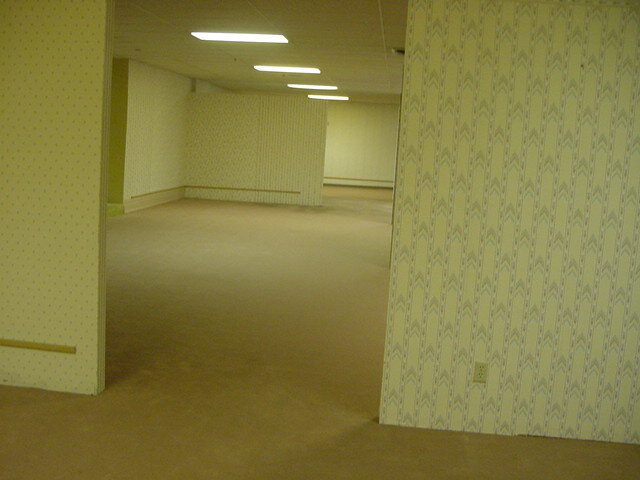
The Backrooms are a symptom of the commodification pervading liminal space iconography. What were once rich, complex ideas now come pre-packaged in a convenient aesthetic. Urban wastelands and liminal spaces have become content to be consumed. The iconography has even bled into Garry’s Mod, where the player marketplace has been flooded with worlds manufactured to elicit a specific set of pre-associated emotions. Many explicitly recreate the Backrooms. In designing such an experience, however, we sacrifice the indeterminacy that originally defined it. After all, if that space is designed to evoke a specific notion of hauntology, then it is fulfilling its purpose. It cannot be suspended; it can only elicit hollow echoes of the genuine experiences of urban wastelands.
Specters
Derrida’s original coinage of “Hauntology” refers specifically to the ghostlike continual reappearance of Marxist ideas, despite society’s best efforts to bury them. Marx argues that capitalism amounts to continual change and instability, teetering between economic boom and financial meltdown. Nothing under capitalism is solid—all will eventually be reinvented to meet the changing demands of the market. In its wake, capitalism’s reinvention leaves urban wastelands, industrial dereliction, and, more recently, digital ruins. As Marx’s translators put it: “All that is solid melts into air” (White, 2010).
With each successive financial crisis, the ghost of Marx makes its rounds in online political forums and quiet philosophical debates. And at the height of economic productivity, the specter appears to remind us of the dangers of commodification: In 2014, Nike debuted their ACG (All Conditions Gear) ad campaign, blatantly appropriating the high-contrast, supersaturated cityscape photography of rooftopping and urban climbing. Kindynis laments that Nike’s ACG is unlikely the first and by no means the last effort to cash in on the latest edgy urban marketing opportunity (Kindynis, 2017).
Like Marx, sublimity haunts modern culture. The sublime cycles in and out of relevancy, rising from its 19th-century grave only to recede back after spooking academia. The “contemporary sublime” has made its rounds recently, a new and further mangled interpretation of the idea. Cultural theorist Luke White understands the contemporary sublime as a matter of our culture’s haunting by the history of sublimity—and its repression by capitalism (White, 2010). First, we experience the sublime through nature. Then, we smother it, conquering nature with urbanization and industrialization. Time passes. Our cities deteriorate, our industry rusts over, and sublime nature reclaims the fruits of our efforts. Urban wastelands are haunted by the traces of people who inhabited them, their failed dreams of a brighter future, and the history of sublimity itself.
The Plaza VI
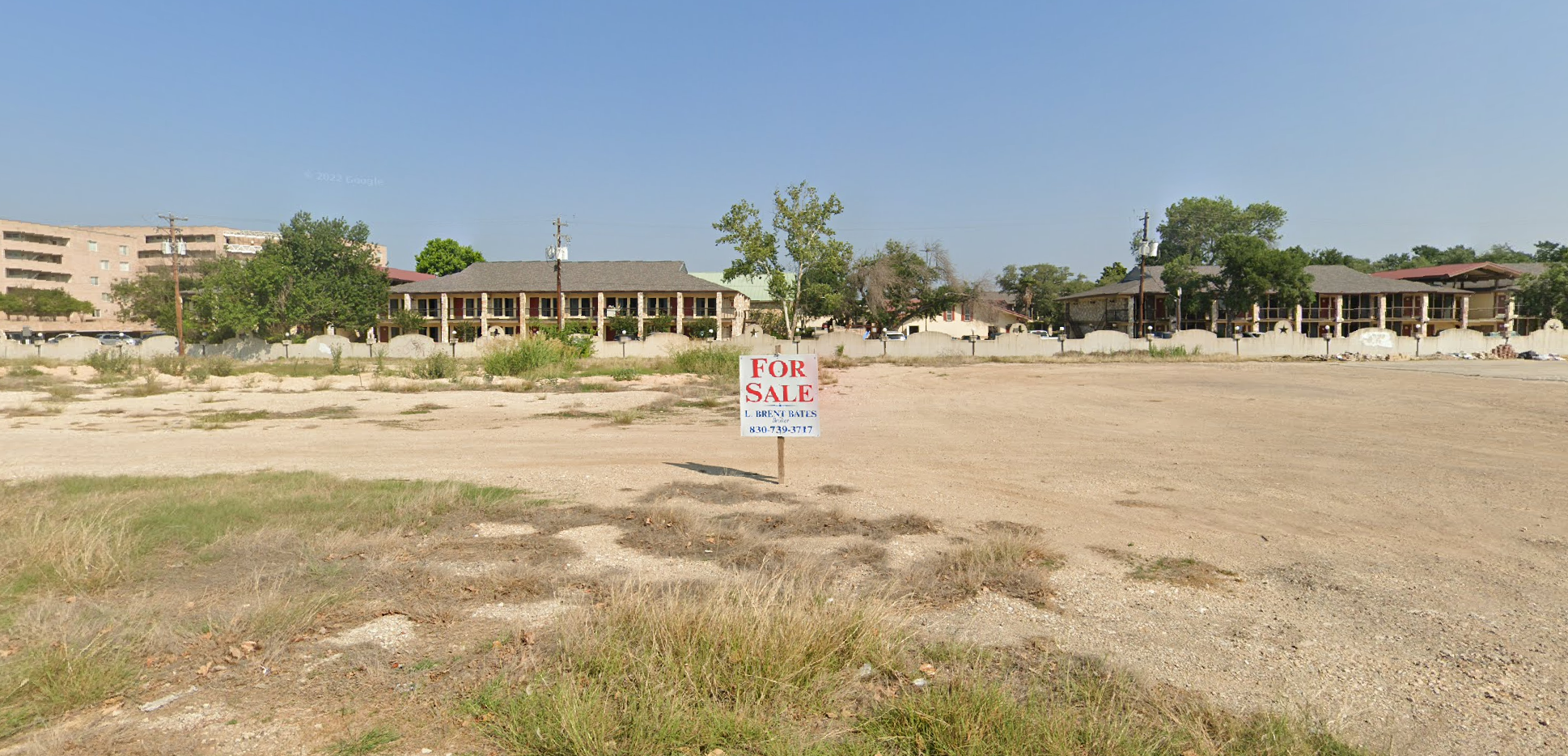
The Plaza VI is long gone. In its place is an empty lot marked by a lone for-sale sign—a commercial headstone. I watched the demolition with bated breath, waiting for the angry spirits to lash out, Poltergeist-style. But there was no spectacular display. The building was quietly reduced to rubble, and the rubble was trucked away to some unmarked grave. There are no traces of the Plaza VI left to haunt my hometown; it has been fully exorcized. But when I drive past the empty lot, where green grass has begun to poke through the gravel, I can still feel its presence.
When I visit again, I will bring flowers.
References
Armstrong, D. H. (2006). Time, Dereliction and Beauty: An Argument for ‘Landscapes of Contempt’.
Bell, D. (2017, April 29). DEAD MALL SERIES: THE END OF KMART. YouTube.
Brady, E. (Ed.). (2013). The Kantian Sublime I: Pre-Critical and Critical Work. In The Sublime in Modern Philosophy (pp. 47–66). Cambridge University Press.
Derrida, J. (1994). Specters of Marx: The state of the debt, the work of mourning and the new international. Routledge.
Fisher, M. (2012). What Is Hauntology? Film Quarterly, 66(1), 16–24.
Fitzgerald, M. (2021, September 23). The Sublime: An Aesthetic Concept in Change. TheCollector.
Hill, C. B. (2022, June 23). *VERY DISTURBING ENCOUNTER* Exploring Westinghouse Factory at Night! YouTube.
Kindynis, T. (2017). Urban Exploration: From Subterranea to Spectacle. The British Journal of Criminology, 57(4), 982–1001.
Kultuurikatel & Tallinn Creative Hub. (2020). Our History.
Miller, V., & Garcia, G. C. (2019). Digital ruins. Cultural Geographies, 26(4), 435–454.
Riley, J. A. (2017). Hauntology, Ruins, and the Failure of the Future in Andrei Tarkovsky’s Stalker. Journal of Film and Video, 69(1), 18–26.
Tarkovsky, A. (Director). (1979). Stalker. Janus Films.
Unt, A.-L., Travlou, P., & Bell, S. (2014). Blank Space: Exploring the Sublime Qualities of Urban Wilderness at the Former Fishing Harbour in Tallinn, Estonia. Landscape Research, 39(3), 267–286.
White, L. (2010). Damien Hirst’s shark: Nature, capitalism and the sublime. Tate Papers, 14.
-
Tallinn has recently undergone rapid economic transformation and has begun repurposing its abandoned industrial sites. One such site is the Kultuurikatel, an abandoned power plant and filming location for Tarkovsky’s Stalker. The site was renovated into a creative workspace and art venue in 2015, preserving the rusting industrial skeleton of the building (Kultuurikatel, 2020). Its repurposing is in line with architect Florian Beigel’s philosophy regarding designing around derelict sites. ↩
-
In Specters of Marx, Derrida criticizes Fukuyama’s positive view of the “end of history”—that we should celebrate capitalism’s ideological victory. Instead, Derrida argues that alternative ideologies are more important than ever. ↩
-
Stalker has skyrocketed in popularity in the West since its Criterion Blu-Ray release in 2017. In 2019, Criterion launched its streaming service, the Criterion Channel, including Stalker in its day-one catalog, and the film is consistently one of its most-streamed movies. ↩
-
Creepypasta is an internet horror trend popularized in the early 2010s by “Slender Man.” A creepypasta is a horror story usually revolving around an original character, often exploring anxieties relevant to the internet age. ↩